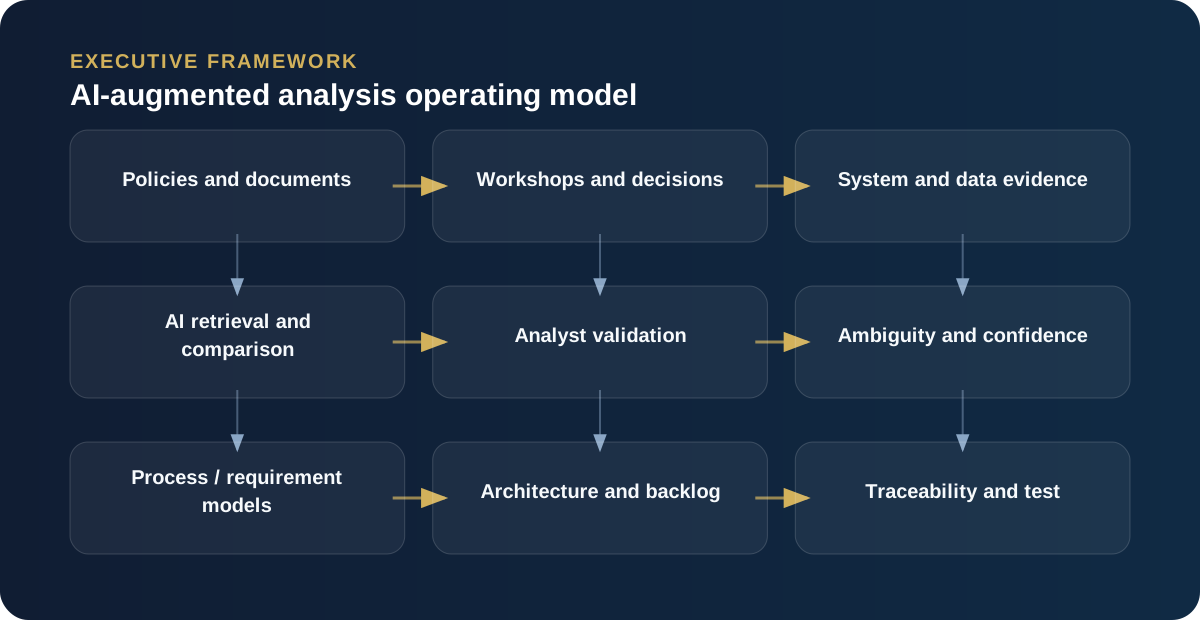
The analyst role is moving from document production toward evidence orchestration. That is a positive shift. Much of the traditional workload—meeting summaries, document comparison, first-draft process descriptions, requirements formatting, traceability updates and backlog administration—can be accelerated dramatically.
The part that remains is the part organisations need most: making sense of conflicting evidence and turning it into decisions.
Analysis is a knowledge-integration problem
A transformation analyst may need to reconcile legislation, policy, current-system behaviour, stakeholder statements, data, vendor capability, technical constraints and delivery history. None of those sources is automatically authoritative for every question.
AI can retrieve and compare them at a scale that a person cannot. The analyst's value moves toward source selection, conflict resolution, confidence, facilitation and decision framing.
Build an evidence workspace, not a prompt habit
Ad hoc prompting is useful for individual productivity. A team-level operating model needs more structure. Project artefacts should be searchable with permissions, versions and source metadata. Important outputs should cite or link back to evidence. Decisions should be separated from generated suggestions.
This also reduces the “lost context” problem when team members change. The analysis corpus becomes an organisational asset rather than a collection of personal notes.
Let AI do the first comparison
Consider a business process that appears in three places: a procedure document, a CRM workflow and stakeholder workshop notes. AI can quickly produce a comparison showing steps that agree, steps that differ and rules present in only one source. The analyst can then focus the workshop on the differences instead of spending the session reading documents aloud.
Similarly, AI can compare user stories against a process model, map requirements to test cases, identify duplicated backlog items or flag when a new design contradicts a previous decision.
Confidence needs to become visible
Traditional project documents often present every statement with the same authority. AI-augmented analysis should improve this by attaching confidence and source status: confirmed policy, observed system behaviour, stakeholder preference, inferred rule, unresolved assumption.
That distinction is crucial because AI can make an inference sound like a fact. The analyst must make epistemic status explicit.
The analyst becomes a stronger bridge to architecture
When evidence can be synthesised quickly, analysts can spend more time exploring solution implications. A process change can be mapped to data entities, security roles, integration events and reporting requirements. A policy change can be traced to affected cases and tests.
This does not turn the business analyst into an architect. It makes the hand-off between disciplines more informed.
New analyst competencies
- Evidence design: deciding what sources should be used and how authority is represented.
- AI evaluation: checking whether generated outputs are complete, grounded and useful.
- Decision facilitation: turning detected contradictions into stakeholder decisions.
- Model thinking: working across process, data, capability and system views.
- Traceability stewardship: keeping business intent connected to implementation and test.
- Prompt and workflow design: creating repeatable analysis patterns rather than one-off prompts.
What not to automate away
Do not optimise away the conversations where stakeholders disagree, because that disagreement is often where the requirement lives. Do not accept generated process models without observing how work actually happens. Do not let a model decide which source is authoritative when the organisation itself has not resolved that question.
AI gives analysts leverage over volume. Judgement determines whether that leverage creates clarity or simply more polished noise.
The analyst’s unit of work becomes an evidence package
Traditional analysis often produces documents sequentially: notes, process map, requirements, user stories, data dictionary. AI makes it possible to work more continuously. Workshop transcripts, policy, system behaviour, data profiling and stakeholder decisions can be maintained as an evidence set from which different artefacts are generated and checked. The analyst’s role shifts toward curating that evidence, resolving contradictions and deciding what is authoritative.
This is a material change in productivity. Instead of spending hours reformatting the same information for different audiences, the analyst can spend more time on ambiguity, exceptions, business rules and consequences. But the quality of the result depends on disciplined source management. If the evidence set mixes draft policy, superseded decisions and unverified notes without provenance, the model will reproduce that confusion at speed.
Design a review loop around high-risk artefacts
Not every output needs the same review. A meeting summary can be corrected cheaply. A financial rule, eligibility criterion or interface mapping may drive production behaviour. I would classify artefacts by consequence and require stronger validation for those that affect money, statutory decisions, safety, data migration or external contracts.
Measure analysis by decision readiness
Counting stories written is not a useful indicator of analysis quality. Better signals include unresolved decision age, percentage of critical requirements with identified source and acceptance evidence, number of conflicting rules outstanding, data objects profiled, and the proportion of backlog entering development without clarification. If AI-assisted analysis improves those measures, it is helping the programme. If it simply increases document volume, it is automating administration.