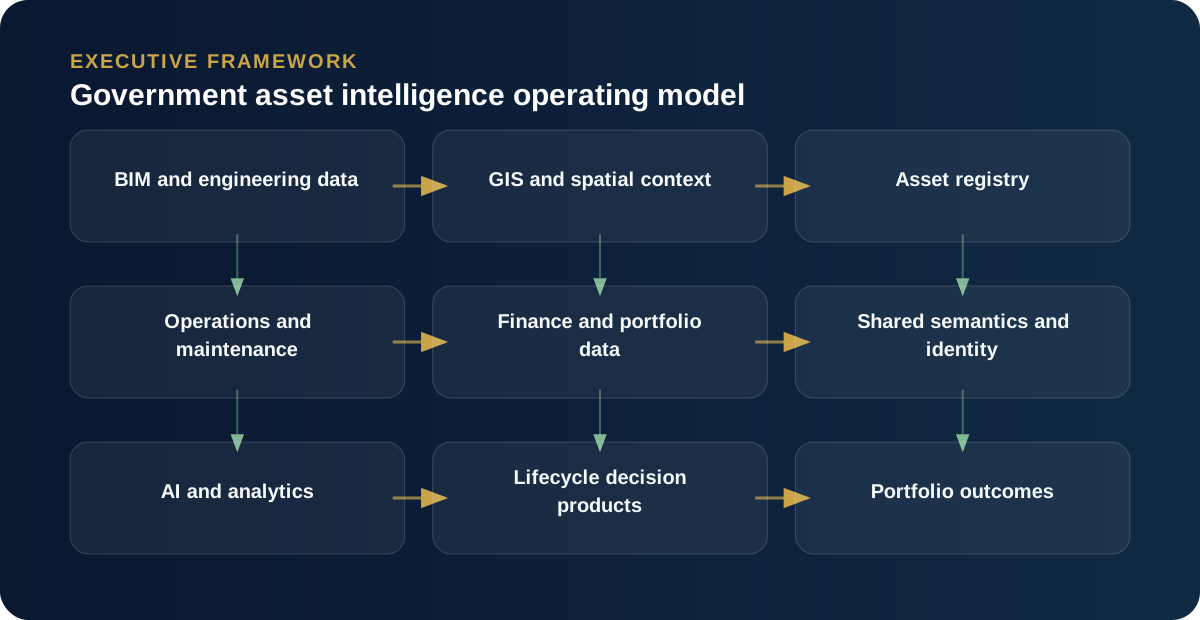
BIM describes assets richly. GIS describes where assets exist and how they relate spatially. Operational systems describe what is happening to them. AI can connect those views—but only if the information model is coherent.
Government agencies manage roads, buildings, land, utilities, facilities, public spaces and other long-lived assets. Information is often spread across capital-project BIM environments, GIS platforms, maintenance systems, document repositories, financial systems, sensor platforms and spreadsheets. Each system can be useful while the portfolio view remains fragmented.
Move from project information to lifecycle information
BIM programmes often focus on design and construction handover. The higher-value question is what information operations will need for the next twenty or fifty years. Asset identity, hierarchy, location, maintainable components, warranty, condition, criticality, documents and service relationships should survive the transition from project to operation.
ISO 19650 is useful because it frames BIM as information management across the asset lifecycle rather than as a modelling tool. That lifecycle perspective should shape the architecture.
GIS provides the portfolio context
A building model is detailed, but government decisions often need to understand networks, catchments, communities, hazards, jurisdictions and nearby assets. GIS provides that broader spatial context.
Linking BIM and GIS enables questions such as: Which facilities in a flood-prone area contain critical plant nearing end of life? Which planned road projects intersect underground assets? Which public buildings have accessibility upgrades due within a particular service region?
Do not build a digital twin with no decision owner
“Digital twin” can become a technology destination without a clear operational purpose. I would define decision products first: capital planning, maintenance prioritisation, emergency impact assessment, energy optimisation, compliance, occupancy or portfolio rationalisation.
Each decision product needs a subset of asset data, quality thresholds, update frequency and accountable owner. The twin then becomes an information capability supporting decisions rather than an expensive visual replica.
AI changes the accessibility of asset intelligence
Once asset information is connected, AI can make it easier to use. A manager could ask which facilities have recurring failures, high consequence, unresolved maintenance and exposure to a forecast hazard. An engineer could retrieve relevant drawings, inspection history and similar defects. A portfolio team could generate an evidence-backed candidate capital programme.
The AI should orchestrate structured queries and retrieve governed documents. It should not invent asset facts when source data is missing.
Semantics are the real integration layer
Different systems may use different identifiers and classification schemes for the same asset. AI will not magically solve that. The organisation needs a canonical asset identity or reliable cross-reference, common classification and machine-readable relationships.
Recent OGC work on AI-ready geospatial ecosystems and digital-twin interoperability reinforces this point: semantic alignment and discoverability are prerequisites for reliable machine use.
A target operating architecture
- Asset registry: canonical identity, hierarchy, ownership and criticality.
- GIS: authoritative location, networks, boundaries and spatial relationships.
- BIM / engineering information: detailed component and project information.
- Operational systems: maintenance, inspections, work orders, sensors and incidents.
- Financial and portfolio data: cost, capital plans, depreciation and investment.
- AI and analytics layer: retrieval, anomaly detection, scenario analysis and decision support.
The executive opportunity
The goal is not a single mega-platform. It is an information operating model in which authoritative systems remain clear, shared asset identity connects them, spatial context enriches them, and AI helps decision-makers navigate the combined evidence.
Government organisations that achieve that will move from reporting on asset inventories to actively managing service risk, investment and resilience across the portfolio.
Start with decisions the asset owner needs to improve
BIM, GIS and AI programmes can become technology catalogues very quickly. I would anchor them in lifecycle decisions: where should capital be spent; which assets create the greatest service risk; what maintenance should be brought forward; how will a project affect surrounding networks; which facilities are exposed to hazard; and what information must transfer from project delivery into operations?
Those questions reveal the minimum information relationships required. They also prevent the organisation from trying to create a perfect digital twin of everything before any value appears.
Create an asset information contract
For each critical asset class, the owner should define canonical identity, hierarchy, spatial reference, required attributes, authoritative source, update responsibility and the handover information expected from projects. This is where ISO 19650-style information management becomes operationally useful. The contract creates a stable spine across BIM models, GIS layers, enterprise asset management and finance.
AI should navigate the lifecycle, not become another silo
Once the information is connected, AI can answer questions across traditionally separate systems: show assets in a hazard area with overdue inspections; explain why lifecycle cost has changed; find drawings and maintenance history for a component; identify similar failures; or summarise the investment case for a renewal package. The value comes from navigating governed evidence rather than creating a new AI-owned copy of the asset estate.
The implementation sequence matters
I would start with a small set of high-value asset classes, establish identity and spatial alignment, connect operational and financial data, deliver two or three decision products, then expand. That sequence creates pressure for the data to become usable and demonstrates value to asset owners. A programme that begins with an enterprise-wide model definition and no operational decision can spend years improving information without changing asset outcomes.