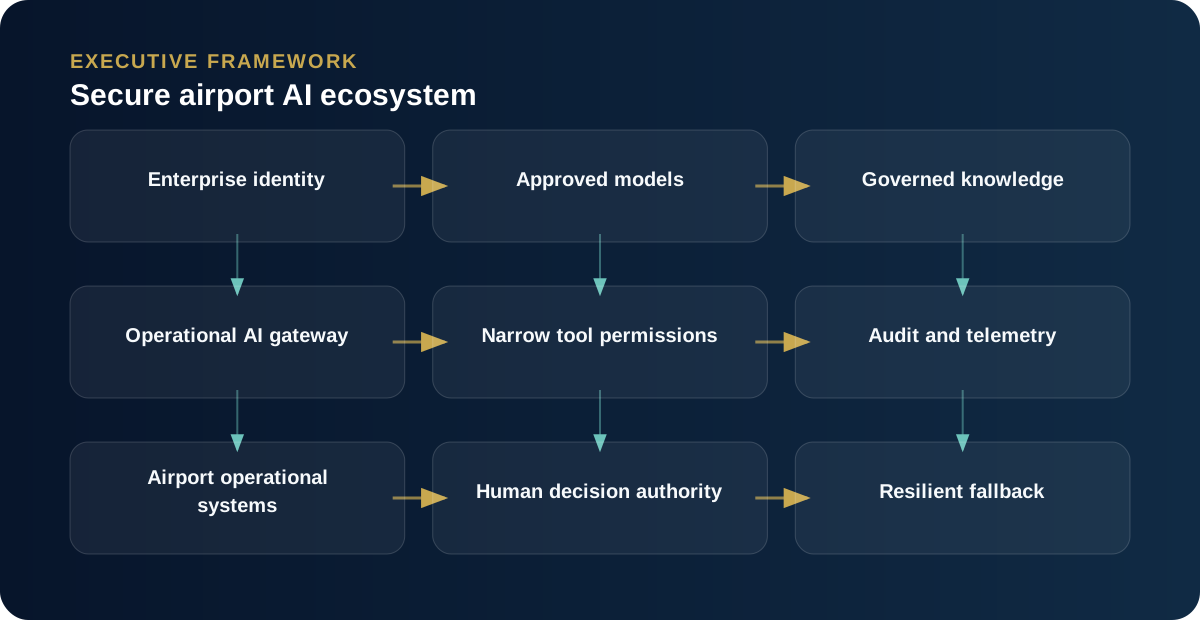
In airport operations, an AI solution is only valuable if it can be trusted inside the operational control environment. That means identity, data classification, network boundaries, approved tools, model access, telemetry and human authority must be designed together.
Airports are unusual technology environments. Passenger systems, baggage, ground support, cargo, security, facilities, airside operations, airline systems and vendor platforms coexist with strict availability requirements and significant safety and security obligations. A generic public AI service may be useful for low-risk productivity, but it is not an operating architecture.
Define the closed ecosystem by information boundary
“Closed AI” should not mean isolated from everything. It should mean that the organisation controls which information enters the AI context, which models are approved, which tools the AI can invoke, where outputs are stored and who can access them.
For sensitive operational use, the architecture may use private network connectivity, enterprise identity, data-loss controls, approved model endpoints, retrieval over governed content and explicit API allow-lists. The exact technology varies. The principle does not.
Separate productivity AI from operational AI
A staff member asking AI to summarise a generic document is not the same risk as an agent receiving live stand allocation, passenger flow, security or ground-support data. The enterprise should classify AI use by operational consequence and data sensitivity.
This creates multiple service tiers. A general productivity tier can use broad enterprise controls. A business-sensitive tier may be grounded on internal knowledge. An operational tier may require stricter model, network, identity, audit and tool controls. Safety- or security-critical decisions may remain human-only.
Agents should receive capabilities, not broad system access
An operational AI agent should not be given a powerful service account and told to “help operations”. It should be given narrowly defined capabilities: retrieve a turnaround status, query a maintenance knowledge base, identify resource conflicts, prepare a shift brief, open a service ticket or recommend an escalation.
Each tool should have its own permission and input validation. This limits the blast radius of model error and makes actions traceable.
Protect the knowledge layer
Grounded AI is only as trustworthy as the knowledge corpus. Airport procedures, maintenance documentation, emergency plans and operational instructions change. The retrieval layer needs versioning, access control, effective dates and ownership.
If an AI assistant retrieves an obsolete procedure faster than a person could, the technology has increased risk rather than reduced it.
Design for degraded modes
24/7 operational technology has to fail gracefully. AI services will be unavailable at times. External model providers may have incidents. Network segmentation may isolate a service. The operating process should remain viable without AI.
That usually means AI enhances an existing workflow rather than becoming the only path to complete it. Critical operational decisions should have deterministic fallbacks and clear operator procedures.
Use a security and authority envelope
- Approved models and hosting patterns.
- Identity-based access to every data source and tool.
- Data classification and prompt/output controls.
- Network and API boundaries for operational systems.
- Audit of retrieval, recommendation and actions.
- Human approval for consequential operations.
- Fallback process when the AI service is degraded.
Secure AI should increase operational confidence
The business case for airport AI is not that it gives everyone unrestricted access to a powerful model. It is that the organisation can safely turn fragmented operational information into faster, better decisions.
A closed and governed ecosystem creates the conditions for that value: the model can be capable, but the architecture decides what it is allowed to know and do.
An airport AI environment should be tiered by operational consequence
Not all airport use cases deserve the same controls. Summarising maintenance manuals, assisting software teams and recommending resource allocations have different consequences. I would create trust tiers with progressively stronger requirements for data access, evaluation, human approval, latency, availability and change control. That prevents low-risk experimentation from being strangled by the controls needed for operational systems while protecting critical functions from casual deployment patterns.
Closed does not mean isolated from value
A governed ecosystem can still use capable foundation models. The important question is how data reaches them and what actions can come back. Sensitive operational context should pass through approved gateways with logging, content controls and clear retention terms. Agents should receive narrowly scoped tools rather than broad network access. Retrieval sources should be curated and permission-aware.
Operational resilience changes the architecture
Airport operations cannot assume permanent access to an external model endpoint. For critical use cases, the design needs timeouts, cached knowledge where appropriate, deterministic fallback and a clear manual operating mode. The AI component should fail without taking the core operation with it. That is the same resilience principle applied to any dependency in a 24/7 environment.
The security conversation therefore needs to include more than confidentiality. Integrity, availability, provenance and change control are equally important. A wrong recommendation delivered confidently at the wrong time can be operationally more damaging than a system that simply declares itself unavailable.